
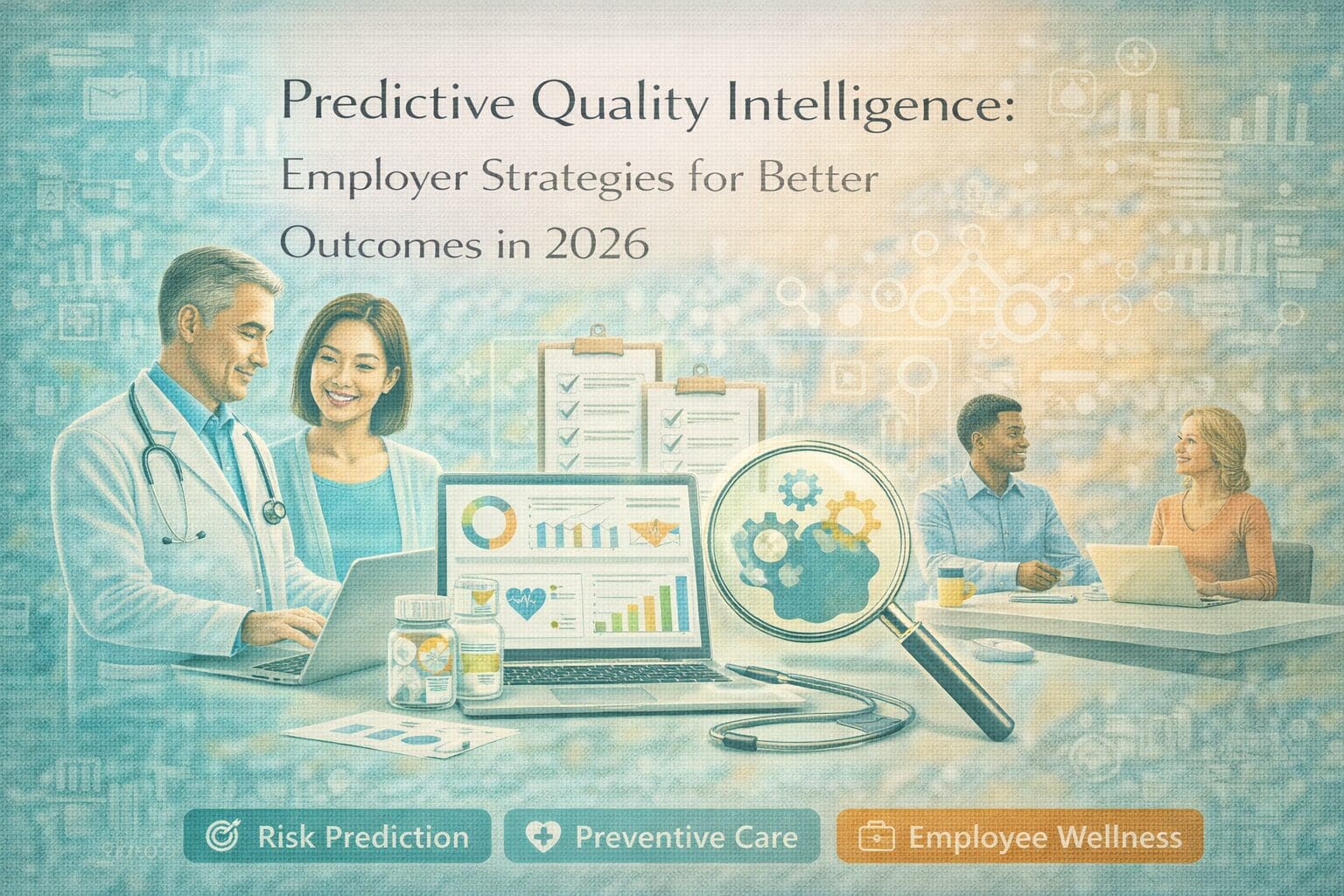
Predictive Quality Intelligence: Employer Strategies for Better Outcomes in 2026
Healthcare strategy is shifting. Instead of reacting to claims after they happen, employers are now looking ahead. Predictive quality intelligence makes this possible by using data to forecast health risks before they become costly problems. The Healthcare Intelligence System (HCIS) notes 45% growth for prospective insights, and early data shows organizations using these approaches can reduce care gaps by 15%.
LifeX Research Corporation operates in connection with an ERISA-governed, self-funded employee benefit plan and does not sell, market, broker, or underwrite health insurance. Our work focuses on studying population-level patterns to generate actionable insights for better health outcomes.
What this article covers:
- The definition of predictive quality intelligence and why it matters for 2026.
- Key trends in predictive quality tools and their capabilities.
- How to implement quality intelligence strategies for measurable benefits.
- Best practices for measuring employer predictive quality outcomes.
What Is Predictive Quality Intelligence and Why It Matters Now
Predictive quality intelligence combines data analysis with health research to estimate future health patterns. It moves beyond traditional reporting, which only shows what has already happened. Instead, it examines current data—like shifts in activity, sleep consistency, or metabolic markers—to identify where risks may be forming.
For employers, this shift is critical. Standard quality metrics are backward-looking. By the time a claim appears, the opportunity for early, low-cost intervention has passed. Forward-looking analytics allows organizations to spot patterns and allocate resources with greater precision. This leads to better health outcomes and more stable costs. Similar approaches are explored in LifeX’s work on anticipating employee health needs, where early pattern detection supports preventive planning.
Predictive Quality Tools and 2026 Trends
Several key capabilities make this possible. First, longitudinal data tracking follows anonymized participant information over months and years. This helps distinguish temporary fluctuations from meaningful trend shifts. Second, behavioral modeling analyzes patterns in sleep, recovery, and stress, which often signal developing issues long before clinical thresholds are crossed. Third, integration with wearable devices provides a continuous stream of real-world data, improving the accuracy of population health forecasts.
These tools work together to create a detailed picture of population health. They do not diagnose individuals. Rather, they highlight areas where supportive programs might be most effective. This distinction is central to ethical research practice. For a broader look at how analytics shape workforce health, see our analysis of population health analytics.
Quality Intelligence Strategies: Key Benefits
Risk prediction tools estimate probability, not certainty. They help researchers highlight emerging patterns without labeling or diagnosing individuals. This supports prevention while maintaining ethical boundaries.
When health risks are identified sooner, supportive programs can be introduced earlier, often reducing the need for intensive treatment later. This aligns with findings from LifeX research on how health data analysis contributes to long-term affordability and planning.
Forecasting improves when consistent longitudinal data is available. Over time, researchers can distinguish between temporary variation and meaningful trend shifts.
Implementing Predictive Outcomes for Employers
Implementing a predictive quality strategy involves several clear steps.
Establish Data Governance
Before any analysis begins, strict privacy controls must be in place. LifeX Research uses anonymized, consent-based datasets. Personal identifiers are removed, preserving statistical value while protecting individual privacy. This aligns with best practices discussed in our research on optimizing patient data privacy.
Integrate Diverse Data Sources
Effective prediction requires rich data. This can include voluntary health risk assessments, de-identified wellness program data, and aggregated biometric information. The goal is to create a comprehensive view of population health trends.
Validate Models Through Research
Predictive models require continuous testing. They are validated through repeat observation and statistical analysis to ensure reliability. This research-driven approach prevents over-reliance on unproven algorithms.
Translate Insights into Action
The final step is turning predictions into a practical strategy. Reports highlight emerging patterns, allowing benefits teams to adjust programs, communications, or resources proactively. The focus remains on population-level support, not individual targeting.
Measuring Employer Predictive Quality Outcomes
Return on investment from these strategies is measured in two areas: financial and clinical. Financial ROI appears through stabilized healthcare costs and reduced need for high-intensity interventions. Clinical improvements are tracked through population-level shifts in key health indicators, such as improved metabolic health or reduced reported stress.
These metrics take time to materialize. Predictive quality intelligence is a long-term strategy, not a quick fix. It supports sustainable change by identifying the root causes of poor health outcomes and addressing them early. This methodical approach is central to how health data research is shaping the future of affordable care.
Quality Intelligence Trends and Best Practices
Several trends are shaping how organizations approach predictive quality in 2026. Advances in wearable integration, behavioral modeling, and longitudinal analytics will continue to refine how early health signals are interpreted. Predictive systems will increasingly support prevention, workforce stability, and long-term planning rather than short-term response.
Organizations seeing the best results share common practices. They invest in clean, consistent data collection. They prioritize transparency with participants about how data is used. They focus on population-level insights rather than individual surveillance. And they continuously validate their models against real-world outcomes.
Final Thoughts
Predictive quality intelligence changes the timeline of healthcare decision-making. It replaces reaction with foresight. For employers, this means less time managing past claims and more time building strategies for future health. By applying rigorous research methods and strong ethical governance, organizations can support better outcomes and greater stability for the years ahead.
LifeX Research continues to study these patterns, providing grounded insight without overstepping into insurance or medical practice. The goal remains simple: help people live healthier, longer, and contribute fully throughout their careers.
