
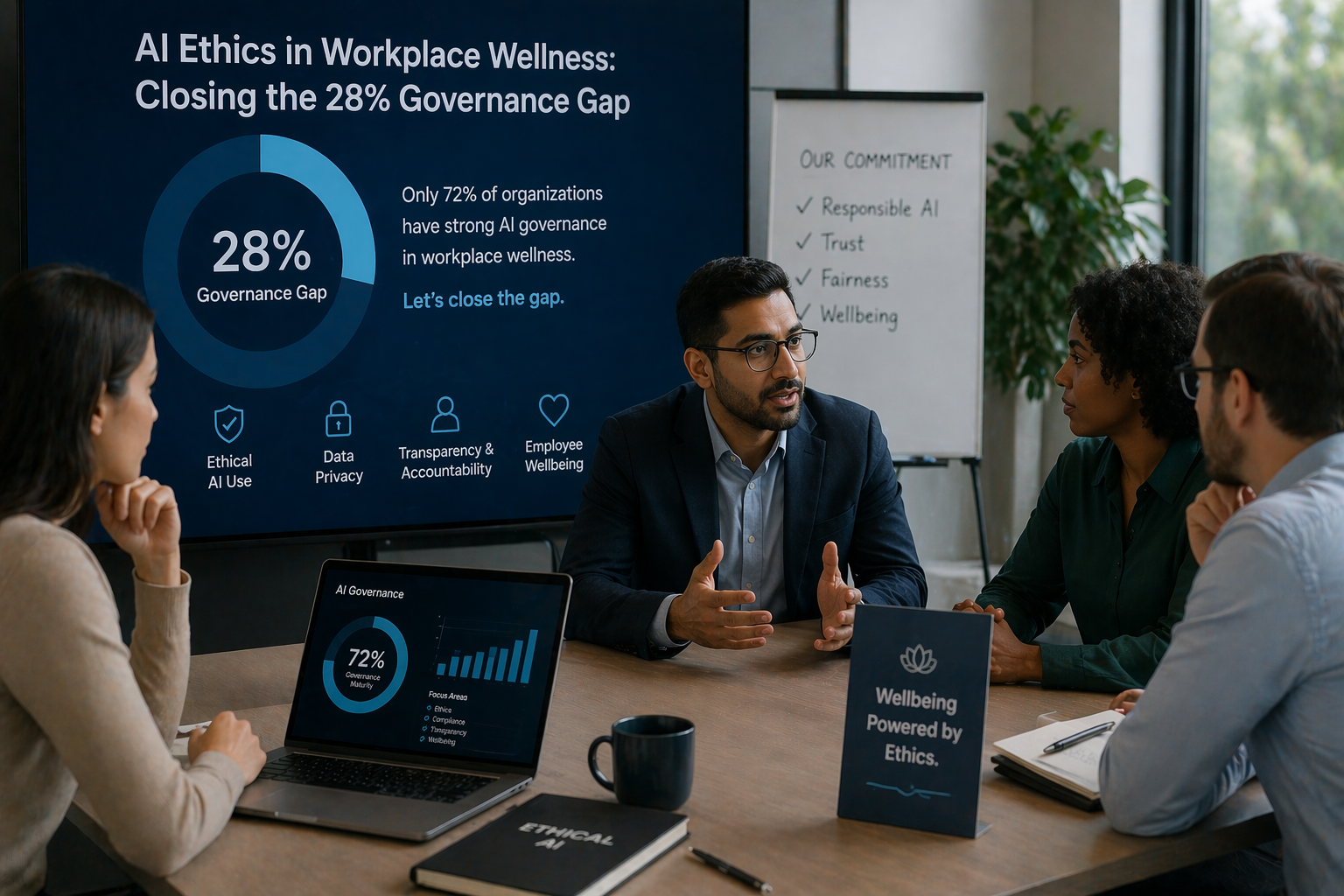
The 28% Problem: AI Governance in Workplace Wellness for 2026
Artificial intelligence is moving faster than the rules meant to manage it. Most employers now offer digital tools to help employees manage stress, fitness, or chronic conditions. However, a significant gap exists between using these tools and governing them. According to NFP research, only a minority of employers report having formal AI governance policies in place.
This lack of oversight creates risks for both the company and the employee. When technology outpaces policy, ethics often take a backseat to efficiency.
What You Will Learn
- Why the 28% governance gap exists and why it is a risk.
- New legal changes coming in 2026, including the Colorado AI Act.
- The difference between helpful health insights and invasive surveillance.
- How to build an ethical framework based on clinical validation and transparency.
- Practical steps for creating a policy that protects employee privacy.
The 28% Problem: Why Policy Lag Matters
The rush to adopt AI in workplace wellness is easy to understand. These tools promise lower costs and healthier teams. But the NFP data reveals a hard truth: the majority of employers adopted these systems before building the guardrails to manage them.
Deploying AI without a policy is like flying a plane while still reading the manual. Without clear rules, companies struggle to answer basic questions about data ownership, bias, and long-term privacy. LifeX Research data shows that this “tech-first, rules-later” approach often leads to employee distrust. When people do not know how an algorithm views their health, they are less likely to participate in wellness programs.
New Regulations Arriving in 2026
The era of “voluntary” AI ethics is ending. State and federal lawmakers are stepping in to fill the gap. Employers must prepare for a more regulated environment by 2026.
The Colorado AI Act is a primary example. It introduces a risk-based framework that the Colorado AI Act establishes requirements aimed at identifying and mitigating potential algorithmic discrimination.” Similarly, Illinois HB 3773 focuses on bias testing and disclosure. These laws mean that “we didn’t know the AI was biased” is no longer a valid legal defense.
Federal proposals also suggest a future where AI transparency is mandatory in employment. Companies will likely need to explain exactly how health data influences decisions. Staying ahead of these changes requires moving beyond basic compliance and into active governance. Understanding emerging health trends and ethical data use is the first step in preparing for this shift.
The Consent Illusion in Workplace Wellness
When an employer offers an AI-driven wellness tool, the employee usually clicks “accept.” But is that “yes” truly voluntary? In a professional setting, power dynamics often cloud meaningful consent.
Employees may feel that opting out makes them look less committed to the company culture. They might fear that refusing to share health data could impact their future promotions or insurance premiums. This creates a “consent illusion.”
LifeX Research analysis indicates that true consent requires more than a checked box. It requires a clear explanation of what happens to the data if an employee leaves the company. It also requires a guarantee that health data will never reach the desks of managers or HR decision-makers.
Drawing the Line: Insight vs. Surveillance
The most critical part of AI ethics is defining the boundary between helpful insight and workplace surveillance. AI that informs organizational planning is valuable. For example, knowing that a significant portion of a workforce may show indicators associated with burnout allows a company to improve its ERISA-based employer health models to provide better support.
Surveillance is different. Surveillance happens when AI monitors individual behavior to judge performance. If a tool tracks how many hours an employee sleeps and then shares that with a supervisor, the line has been crossed.
LifeX Research advocates for a “population-level only” approach. This means data is grouped so no single person can be identified. The goal is to improve the health of the group, not to put a microscope on the individual.
HERO Think Tank Guardrails
The Health Enhancement Research Organization (HERO) has proposed several guardrails for ethical AI. These standards help ensure that wellness programs do more good than harm.
- Clinical Validation: Does the tool actually work? AI should be backed by peer-reviewed science, not just clever marketing.
- Human Oversight: An algorithm should never have the final word on a person’s health status.
- Bias Audits: Employers must regularly check if the AI treats different demographic groups fairly.
- Transparent Communication: Employees deserve to know how the “black box” of AI makes its predictions.
Following these guardrails helps build an environment where technology supports the human element of work.
Building a Governance Framework: Practical Steps
Closing the 28% gap does not have to be an impossible task. Employers can begin by taking a few practical steps.
First, conduct a vendor audit. Ask existing wellness providers how they test for bias and where they store data. If a vendor cannot explain their privacy logic in plain English, that is a red flag.
Second, develop a clear, written policy. This document should state that participation is 100% voluntary and that data is de-identified. It should also specify that third-party administrators handle the data so the employer never sees individual records.
Third, communicate often. Don’t just send one email. Explain the benefits of the AI tool while being honest about the protections in place. Transparency is the best way to turn a skeptical employee into a willing participant.
Finally, schedule a regular review. AI evolves. A policy written today may be outdated by next year. A yearly check-up ensures the governance stays as smart as the technology it manages.
Why Ethical Governance Wins
In the end, ethics are a competitive advantage. Companies that respect data privacy and avoid invasive surveillance will attract better talent. People want to work for organizations that treat them as human beings, not just sources of data.
AI may help identify patterns associated with health risks, enabling earlier awareness and support.. But that power only works when it is built on a foundation of trust. By closing the governance gap, employers can ensure that their wellness programs are both innovative and ethical.
LifeX Research Corporation is a health data research organization that analyzes real-world health trends, behavioral signals, and population health patterns. The organization operates in connection with an ERISA-governed, self-funded employee benefit plan and does not sell, market, broker, or underwrite health insurance.