
Quick Answer
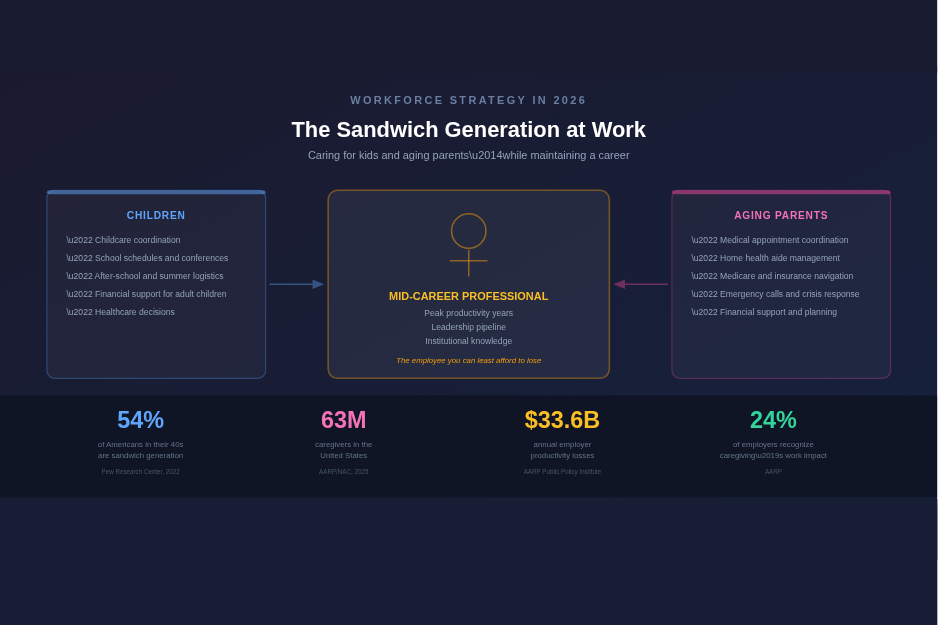
Sandwich generation employees are one of the fastest-growing workforce demographics in the United States? The sandwich generation refers to mid-career adults—typically in their 40s and 50s—who simultaneously care for aging parents and support their own children. According to Pew Research Center (2022), 54% of Americans in their 40s are in this position. With an estimated 53 to 63 million caregivers in the U.S. (AARP/National Alliance for Caregiving), and employer productivity losses estimated at up to $33.6 billion annually (AARP Public Policy Institute), sandwich generation caregiver support is increasingly recognized as a workforce strategy issue—not a personal one.
The Sandwich Generation at Work: Employer Strategies for Supporting Caregivers in 2026
A senior project manager logs on at 7:15 a.m. She’s already been up for two hours. Before her first meeting, she coordinated a home health aide visit for her mother’s physical therapy, confirmed her daughter’s after-school pickup, and exchanged three texts with a sibling about their father’s medication change.
By noon, she will have missed a team standup because the aide didn’t show. By 3 p.m., she will leave early for a parent-teacher conference. She will finish her actual work after 9 p.m., running on four and a half hours of sleep because her father called at 2 a.m. confused about his insulin.
Her manager sees a reliable performer whose output has slipped. HR sees increasing PTO requests. Neither sees the structural pressure behind both.
This is the sandwich generation at work. And it is not a niche concern—one of the most significant workforce trends affecting employers in 2026.
retention, and organizational resilience in 2026.
The Sandwich Generation: Not a Trend—A Structural Shift
The term describes adults who simultaneously provide care or financial support to aging parents while raising or supporting their own children. First articulated by social worker Dorothy Miller in 1981, it has moved from a sociological concept to a workforce planning variable with measurable consequences.
According to a 2022 Pew Research Center survey, approximately 23% of U.S. adults—roughly one in four—are part of the sandwich generation. Among Americans in their 40s, that figure reaches 54%. These are not entry-level employees. They are mid-career professionals in their peak productive and leadership years—the people organizations can least afford to lose and most struggle to replace.
The scale is significant and growing. The AARP/National Alliance for Caregiving’s 2020 report estimated 53 million Americans serving as unpaid caregivers; a 2025 update placed that number at approximately 63 million. Of those, an estimated 29% are simultaneously supporting both children and older adults.
This will not self-correct. The U.S. Census Bureau projects that by 2034, adults 65 and older will outnumber those under 18 for the first time in American history. The caregiving burden on working-age adults will intensify.
The Business Cost That Hides in Plain Sight
Caregiving responsibilities impose costs on employers that often go unrecognized—because they present as performance issues rather than structural ones.
The AARP Public Policy Institute has estimated that U.S. businesses lose up to $33.6 billion per year in productivity associated with full-time working caregivers. This encompasses absenteeism, presenteeism, shifts from full-time to part-time work, and the cost of replacing employees who leave. A separate Gallup analysis estimated that caregiver absenteeism alone costs the U.S. economy $25.2 billion annually, based on an average of 6.6 missed workdays per caregiver per year across the roughly 17% of the full-time workforce providing care.
But the most expensive dimension may be the one that never appears in an HR dashboard: the silent disengagement of experienced professionals who stop raising their hand for leadership opportunities because they cannot absorb additional time commitments. AARP has reported that nearly one-third of caregivers have left a job at some point to care for an aging relative—and the replacement cost for mid-career professionals typically runs 50–200% of annual salary.
Where Caregiving Pressure Surfaces in the Workforce
A common misperception is that caregiving is primarily a women’s issue or a low-wage issue. Pew Research data shows that men and women are roughly equally likely to be in the sandwich generation. Adults with at least a bachelor’s degree (30%) are more likely to be in this position than those with less education (20%).
The pressure concentrates in a specific demographic band: employees aged 35–55 who hold institutional knowledge, manage teams, and drive operational continuity. It surfaces in predictable ways.
The Accumulation Effect
Caregiving doesn’t announce itself with a single crisis. It accumulates. An employee may manage dual responsibilities effectively for months before the weight becomes visible—and by the time it does, the damage to engagement, health, and career trajectory may be significant.
| Visible Signal | What HR Often Sees | What May Be Driving It |
| Increasing PTO requests | Employee taking more time off | Managing medical appointments, school obligations, and care coordination for multiple dependents |
| Declining meeting attendance | Disengagement or time management issues | Unpredictable caregiving emergencies: a parent falls, an aide cancels, a child is sent home sick |
| Output quality dip in a reliable performer | Performance concern | Chronic sleep deprivation from overnight caregiving combined with full work responsibilities |
| Passing on promotions or stretch assignments | Lack of ambition | Cannot absorb additional hours or travel demands while managing dual care responsibilities |
| EAP utilization increase | Personal stress | Caregiver burnout: financial anxiety, decision fatigue, guilt, isolation |
At the population level, these signals can be analyzed in aggregate—without identifying any individual—to reveal where caregiving pressure may be affecting workforce capacity and where targeted support could have the greatest impact.
What Sandwich Generation Employees Actually Need
The conventional response—more PTO—misunderstands the problem. Caregiving demands are not vacation. They are unpredictable, recurring, and emotionally exhausting in ways that standard leave policies were not designed to accommodate.
Research from caregiver advocacy organizations and workforce studies points to several categories of support that tend to address the most pressing gaps.
Flexibility That Goes Beyond the Calendar
The need is often not for full days off, but for the ability to shift a start time by an hour, step away for a medical appointment, or work asynchronously when overnight caregiving disrupts sleep. Organizations moving toward outcomes-based performance evaluation—measuring what gets done rather than when someone is at a desk—may find this flexibility easier to operationalize.
Backup Care and Eldercare Navigation
When a home health aide cancels or childcare falls through, the employee faces a binary choice: miss work or leave a dependent without care. Backup care programs—providing access to vetted, short-notice childcare or elder care—can prevent these forced absences. Eldercare navigation services, which help employees coordinate Medicare, long-term care options, and home health logistics, address a time-consuming burden that few employees have expertise in managing.
Mental Health Support Designed for Caregivers
The National Alliance for Caregiving has found that sandwich generation caregivers providing 20 or more hours of care per week frequently begin reporting symptoms of depression and anxiety. Standard EAP utilization may help, but caregiver-specific support—peer groups, resilience programs, respite planning, and low-barrier counseling access—can address the particular form of burnout that dual caregiving produces.
Financial Planning That Reflects Dual Pressure
Employees simultaneously managing childcare costs, eldercare expenses, their own retirement, and potentially their parents’ medical costs face financial complexity that generic retirement planning does not address. Financial counseling that accounts for caregiving-related expenses, long-term care planning, and dependent care tax strategies can provide meaningful relief—particularly as new legislative changes create additional planning opportunities.
The 2026 Dependent Care FSA Update
Effective January 1, 2026, the annual contribution limit for Dependent Care Flexible Spending Accounts increased from $5,000 to $7,500 per household ($3,750 for married individuals filing separately) under the One Big Beautiful Bill Act. This represents the first permanent increase in the dependent care FSA limit since 1986.
For sandwich generation employees, this increase may be particularly relevant. Dependent care FSAs allow pre-tax contributions to cover eligible care expenses for dependents under age 13 as well as adults who are physically or mentally incapable of self-care and share the employee’s home for more than half the year—which can include aging parents receiving in-home care.
The new limit is not indexed to inflation, meaning it remains fixed unless future legislation changes it. Organizations exploring how to communicate this update to employees may find it useful to frame it alongside broader caregiving support rather than as an isolated benefits line item.
Note: This information reflects the current statutory limit and is provided for educational purposes. It does not constitute tax advice. Individual tax situations vary, and employees may wish to consult a qualified tax professional. The enhanced Child and Dependent Care Tax Credit under the same legislation may be more advantageous for some households, particularly those with lower adjusted gross income.
Where Traditional Benefits Design Falls Short
Most employer benefits packages were designed around assumptions that no longer reflect how mid-career employees live: a linear career trajectory, predictable dependent needs, and a clear separation between “work problems” and “home problems.”
The sandwich generation disrupts every one of those assumptions. Leave policies designed for illness or vacation don’t accommodate the rolling, unpredictable logistics of dual caregiving. Health benefits that serve the employee and their children don’t address the hours spent coordinating a parent’s Medicare, supplemental coverage, and provider appointments. Wellness programs focused on individual health behaviors don’t reach the caregiver whose health is deteriorating because of demands entirely outside the workplace.
The gap is not in coverage generosity. It is in design relevance. Benefits that don’t account for the lived experience of simultaneous caregiving across two generations miss the population segment that most needs support—and that the organization most needs to retain.
What Caregiver-Friendly Policy Design Looks Like
A growing number of organizations are evaluating or implementing policies designed to address caregiving demands directly. AARP has reported that only about 24% of employers currently recognize caregiving’s impact on performance—suggesting that most workplaces have significant room to evolve.
Among the approaches gaining traction:
- Dedicated caregiver leave: Separate from FMLA and standard PTO, some organizations now offer 5–20 days annually that employees can use for eldercare or dependent care without drawing on vacation or sick time.
- Flexible and compressed schedules: Four-day workweeks, core-hours models, and asynchronous work policies give caregivers the ability to manage unpredictable demands without requesting formal leave for every disruption.
- Gradual return-to-work programs: For employees returning from extended caregiving leave, phased reentry—reduced hours or modified responsibilities during a transition period—can prevent the attrition that often follows prolonged absence.
- Manager training on caregiving awareness: When managers understand the structural nature of caregiving pressure, they can adapt workload distribution and expectations proactively, rather than reacting to declining output after the fact.
- Caregiver resource groups: Employee-led groups for caregivers create peer support networks, reduce isolation, and give organizations direct feedback on which policies are—and aren’t—working.
What Workforce Data Can Reveal About Caregiving Pressure
One of the reasons caregiving pressure remains invisible in many organizations is that the signals are diffuse. No single metric captures it. But when workforce data is analyzed at the population level, patterns often emerge.
Aggregate analysis of health claims, EAP utilization, leave patterns, and voluntary health assessment data can reveal convergent signals: increased stress-related healthcare utilization, sleep disruption patterns, rising mental health service access, declining engagement scores, and intermittent attendance issues—all concentrated within a specific demographic band.
These patterns, analyzed without identifying any individual, can help organizations understand where caregiving pressure may be affecting workforce capacity. The analysis is descriptive, not diagnostic—it identifies where to look, not what any individual needs. And it is most effective when it draws on multiple data streams rather than relying on any single source.
How LifeX Looks at Workforce Challenges Like This
LifeX Research Corp. operates as an employer-sponsored health research organization under an ERISA-governed framework. Its research programs are designed to identify population-level health and wellbeing patterns across the workforce—not to make individual care decisions, but to generate aggregate insights that can inform how benefits and support structures are designed.
In the context of caregiving, this means LifeX’s approach can surface patterns that traditional claims data or engagement surveys alone may miss: the convergence of stress markers, sleep disruption, declining engagement, and healthcare utilization changes that, together, may indicate caregiving-related pressure affecting a workforce segment. These insights remain at the population level—no individual is identified or singled out.
For organizations trying to understand whether their workforce includes a meaningful sandwich generation population, and how that population’s needs are or aren’t being met by current benefits, this kind of structured, research-driven analysis can provide a more complete picture than any single data source.
Key Takeaways
- The sandwich generation is not a niche demographic. Pew Research data shows 54% of Americans in their 40s are simultaneously supporting aging parents and their own children. This is a workforce-wide structural shift.
- The business impact is measurable: up to $33.6 billion annually in lost productivity (AARP Public Policy Institute), with additional costs in attrition, disengagement, and lost institutional knowledge among mid-career professionals.
- Caregiving pressure surfaces as performance issues—absenteeism, presenteeism, declining output, passing on promotions—that are often misread as individual problems rather than structural conditions.
- What employees in this position tend to need most is flexibility, backup care, eldercare navigation, caregiver-specific mental health support, and financial planning that reflects dual caregiving pressure—not just more PTO.
- The 2026 dependent care FSA limit increase to $7,500 per household (from $5,000) may create meaningful tax planning opportunities for sandwich generation employees managing both child and elder care expenses.
- Population-level workforce data—analyzed in aggregate without identifying individuals—can reveal where caregiving pressure is affecting the workforce and where support interventions may have the greatest impact.
Frequently Asked Questions
What is the sandwich generation?
The sandwich generation refers to adults—typically in their 40s and 50s—who simultaneously care for or financially support aging parents and their own children. Pew Research Center estimates that 23% of U.S. adults (54% of those in their 40s) are in this position. The term reflects the “squeeze” of dual caregiving demands during peak career years.
How does sandwich generation caregiving affect employers?
Caregiving responsibilities can contribute to absenteeism, presenteeism, reduced engagement, career deceleration, and attrition—often among mid-career employees who hold institutional knowledge and leadership roles. AARP estimates that employer productivity losses associated with working caregivers may reach $33.6 billion annually.
What is the dependent care FSA limit in 2026?
Effective January 1, 2026, the dependent care FSA annual contribution limit increased from $5,000 to $7,500 per household ($3,750 for married individuals filing separately) under the One Big Beautiful Bill Act. This is the first permanent increase since 1986. Eligible expenses can include both childcare and qualifying elder care. Individual tax situations vary, and consulting a tax professional may be advisable.
What can employers do to support sandwich generation employees?
Many organizations are exploring dedicated caregiver leave, flexible scheduling, backup care programs, eldercare navigation services, caregiver-specific mental health support, and financial planning resources. The most effective approaches tend to address the structural nature of caregiving pressure rather than treating it as an individual performance issue.
How can organizations identify caregiving pressure in their workforce?
Population-level analysis of health claims, EAP utilization, leave patterns, and voluntary health assessment data can reveal convergent signals—stress-related utilization increases, sleep disruption, declining engagement scores—concentrated within specific demographic bands. This aggregate analysis can help organizations understand where to focus caregiver support without identifying any individual.
Published by LifeX Research Corp. LifeX Research Corporation is a health data research organization that analyzes real-world health trends, behavioral signals, and population health patterns. The organization operates in connection with an ERISA-governed, self-funded employee benefit plan and does not sell, market, broker, or underwrite health insurance.