
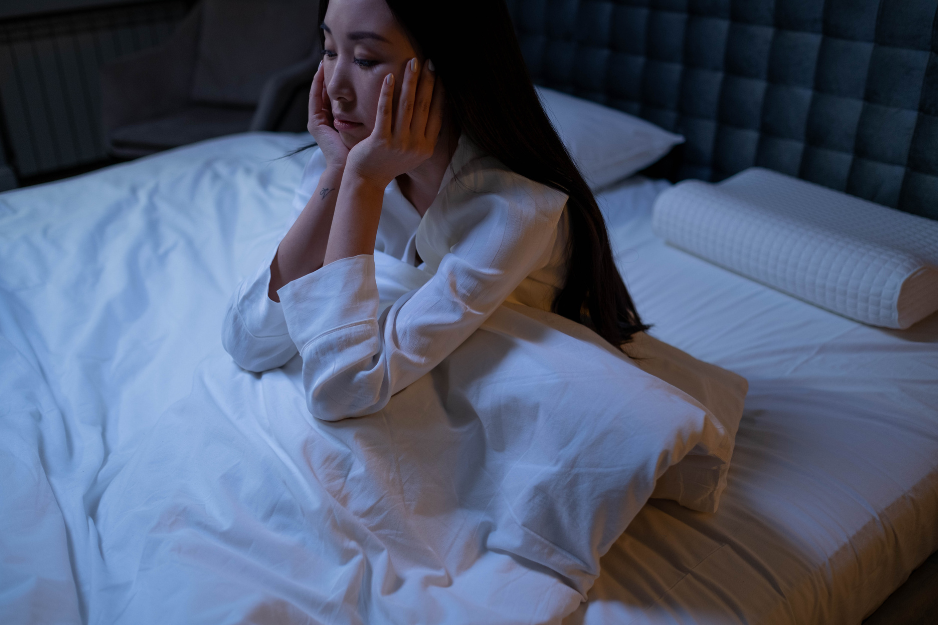
Why is it harder to sleep in summer?
It’s not in your head. A study of 765,000 U.S. residents published in Science Advances found that each 1°C rise in nighttime temperature was associated with approximately three additional nights of insufficient sleep per 100 people per month — with the largest effects during summer (Obradovich et al., Science Advances, 2017). Summer disrupts sleep through two mechanisms: elevated nighttime temperatures prevent the core body temperature drop the brain needs to initiate sleep, and extended evening daylight suppresses melatonin production, delaying the signal to feel sleepy.
Why You Sleep Worse in Summer — and What Actually Helps
It’s July. You’re lying in bed at 11 p.m. with the fan running, the covers kicked off, and the pillow flipped to the cool side for the third time. You’re tired. Your body knows it’s bedtime. But sleep isn’t coming.
Or maybe you fall asleep fine, but you wake up at 4:45 a.m. when the light comes flooding in, and you can’t get back under. Either way, something about summer is stealing your sleep.
It is. And there’s a peer-reviewed, 765,000-person study to back it up. Researchers publishing in Science Advances found that rising nighttime temperatures measurably increase insufficient sleep across the U.S. population — with the effects concentrated in summer, in lower-income populations, and in older adults (Obradovich et al., 2017). A follow-up study in One Earth confirmed the findings with wearable device data from over 7 million sleep records across 68 countries (Minor et al., 2022). This is not a willpower problem. It’s a physiology problem. Here’s what’s happening — and what the evidence says can help.
Why Heat Blocks Sleep
To fall asleep, your brain needs your core body temperature to drop by roughly 1–2°F. This is a physiological prerequisite, not a preference. That temperature decline is part of what triggers melatonin release and the transition from wakefulness to sleep.
When the bedroom is too warm, the body can’t shed heat efficiently. Blood flow increases to the skin surface — that’s why you feel flushed. Sweating kicks in. The cardiovascular system works harder. All of these responses keep the brain in an alert, regulatory state rather than the quiet, cooling state that allows sleep onset.
The Science Advances finding quantifies the effect: each 1°C rise in nighttime ambient temperature was associated with approximately three additional nights of insufficient sleep per 100 people per month (Obradovich et al., 2017). The One Earth study confirmed this with objective data from wearable sleep trackers: warmer nights shortened sleep primarily by delaying sleep onset — people fell asleep later but didn’t sleep in later to compensate (Minor et al., 2022).
The effect is cumulative across summer. It’s not one bad night. It’s weeks of slightly delayed onset and slightly earlier waking that compounds into a measurable sleep deficit by August.
The Daylight Factor — Why You Feel Alert at 10 p.m.
Heat is only half the story. The other half is light.
Summer days are long. In most of the U.S., sunset in June and July falls between 8:30 and 9:00 p.m. or later. That extended evening light — especially the blue-spectrum light from a bright sky — reaches the retina and signals the brain to suppress melatonin production.
Melatonin is the hormone that signals “time to sleep.” When it’s suppressed by light exposure, you feel alert even when your schedule says you need to wind down. This is why you can feel completely awake at 10 p.m. in July but naturally drowsy by 8:30 p.m. in December. The daylight itself is shifting when your brain begins the sleep process.
The combination of heat and extended daylight creates a double disruption: the room is too warm for the core temperature drop, and the brain hasn’t received the melatonin signal to initiate sleep. Both mechanisms push sleep onset later. Together, they’re why summer nights feel fundamentally different from winter ones.
Not Everyone Loses Sleep Equally
This is the finding that elevates the conversation from personal comfort to population health.
The Science Advances study found that the sleep impact of rising nighttime temperatures was roughly twice as strong for lower-income respondents compared to higher-income respondents (Obradovich et al., 2017). Older adults also showed significantly stronger effects.
The mechanism is straightforward: access to cooling. Air conditioning is the primary defense against nighttime heat. Households that cannot afford AC — or cannot afford to run it through the night — bear a disproportionate sleep burden. The same pattern applies to older adults, whose age-related changes in thermoregulation make it harder for the body to cool itself during sleep, even in mildly warm conditions.
This matters because sleep loss is not just discomfort. Chronic insufficient sleep is associated with elevated cardiovascular risk, metabolic disruption, weakened immune function, and cognitive impairment (RAND, 2016). When the sleep burden falls disproportionately on lower-income and elderly populations — groups already at elevated risk for these conditions — the downstream health consequences concentrate in the communities least equipped to absorb them.
Who’s Most Affected
- Older adults (65+): Impaired thermoregulation, higher rates of chronic conditions, more medication use — some of which affects sleep quality independently
- People with cardiovascular conditions: Heat increases cardiac workload during the day. Poor sleep from heat adds a second cardiovascular stressor at night.
- People with respiratory conditions: Hot, humid air can worsen nighttime breathing difficulty, particularly for those with asthma or COPD
- People with existing sleep disorders: Insomnia and sleep apnea are both worsened by elevated bedroom temperatures
- People with limited cooling access: The inequity finding from the Science Advances study applies directly — roughly twice the sleep impact
- Shift workers: Already fighting circadian misalignment from overnight schedules. Summer heat and extended daylight add additional disruption on top of an already challenged sleep system.
(For more on how heat affects people managing chronic conditions or taking daily medications, see our guide to summer heat and chronic conditions.)
What Actually Helps — Evidence-Based Summer Sleep Strategies
Not everything people try for summer sleep is backed by evidence. The strategies below are.
| Strategy | Why It Works | Key Detail |
| Cool the room to 60–67°F | Allows the core temperature drop needed for sleep onset | National Sleep Foundation and Cleveland Clinic recommend this range. Cool the room itself, not just yourself — a warm room with a cold pack on your forehead doesn’t solve the ambient temperature problem. |
| Blackout curtains or an eye mask | Blocks extended summer evening and early morning light that suppresses melatonin | Particularly effective for people who wake too early from summer dawn light at 5–6 a.m. Blackout curtains also reduce room heat from sun-warmed windows. |
| Fan or air circulation | Moving air aids evaporative cooling from the skin, helping the body shed heat | Even with AC, stagnant air can trap warmth near the body surface. A fan supplements the cooling effect. |
| Lukewarm shower before bed | Draws blood to the skin surface; when you step out, rapid evaporative cooling triggers a core temperature drop | Counterintuitive: lukewarm is more effective than cold. Cold water constricts surface blood vessels and can temporarily trap core heat. Lukewarm opens them, then stepping into cooler air accelerates the drop. |
| Limit alcohol before bed | Alcohol fragments sleep — more awakenings, less deep sleep — even though it may help with initial onset | Summer socializing often means more evening drinks. The trade-off is measurable: alcohol-assisted sleep onset leads to worse sleep quality in the second half of the night. |
| Light bedding, breathable fabrics | Reduces heat retention against the skin during sleep | Cotton or moisture-wicking sheets. Heavy duvets and synthetic fabrics trap body heat. Swap bedding seasonally the same way you swap your wardrobe. |
| Consistent sleep-wake timing | Reinforces circadian rhythm despite changing daylight patterns | Resist the pull to stay up later just because it’s still light outside. The body needs the consistent cue. A drifting summer bedtime undermines everything else on this list. |
Why It Matters at Work
Summer sleep loss doesn’t stay in the bedroom. It follows you to your desk.
RAND Corporation estimates that insufficient sleep costs the U.S. economy up to $411 billion annually in lost productivity (RAND, 2016). Workers sleeping fewer than six hours lose approximately six additional productive workdays per year compared to those sleeping seven to eight hours. The mechanisms are cognitive: degraded focus, slower reaction time, impaired emotional regulation, and reduced decision-making quality.
Across a summer where heat and daylight are shaving 20–30 minutes off sleep every night, the cumulative effect is the equivalent of losing multiple productive workdays between June and September. The person who can’t focus in the Tuesday afternoon meeting may not be disengaged. They may be underslept — and the weather is a contributing factor that no amount of coffee fully compensates for.
(For the full analysis of how sleep quality affects workforce performance across all seasons, see our examination of sleep health and employee productivity.)
The Bottom Line
Summer sleep disruption is real, measurable, and physiologically driven. Heat prevents the core temperature drop your brain needs to fall asleep. Extended daylight suppresses the melatonin signal that tells your brain it’s time. The combination pushes sleep onset later and compresses total sleep duration across weeks and months.
The fix is environmental, not motivational. Cool the room. Block the light. Run a fan. Take a lukewarm shower. Limit evening alcohol. Keep your sleep-wake schedule consistent even when the sun says otherwise. These are small adjustments with compounding returns — each night of adequate sleep makes the next day’s focus, energy, and health a little easier to sustain.
It’s not in your head. It’s in the temperature and the light. Now you know what to do about both.
Frequently Asked Questions
Why is it harder to sleep in summer?
Two mechanisms. First, elevated nighttime temperatures prevent the 1–2°F core body temperature drop your brain needs to initiate sleep. Second, extended summer daylight suppresses melatonin production, delaying the signal to feel sleepy. A study of 765,000 Americans found that each 1°C rise in nighttime temperature was associated with approximately three more nights of insufficient sleep per 100 people per month (Science Advances, 2017).
What is the ideal bedroom temperature for sleep?
The National Sleep Foundation and Cleveland Clinic recommend a bedroom temperature between 60°F and 67°F (approximately 15–19°C) for optimal sleep. This range allows the body to shed heat and achieve the core temperature decline needed for sleep onset.
Does a cold shower before bed help you sleep?
A lukewarm shower tends to be more effective than a cold one. Lukewarm water draws blood to the skin surface; when you step out into cooler air, the rapid evaporative cooling triggers a core temperature drop that promotes sleep onset. Cold water constricts surface blood vessels, which can temporarily trap core heat rather than releasing it.
Does alcohol help or hurt sleep?
Both, at different times during the night. Alcohol may help with initial sleep onset, but it fragments the second half of the night — causing more awakenings, reduced deep sleep, and lower overall sleep quality. In summer, when sleep is already disrupted by heat and light, alcohol’s fragmenting effect compounds the problem.
Why do I wake up so early in summer?
Extended summer daylight is the primary cause. Dawn light in June and July arrives as early as 5:00–5:30 a.m. in much of the U.S. Light reaching the retina signals the brain to suppress melatonin and begin waking. Blackout curtains or an eye mask can block this early morning light signal and help maintain sleep through the intended wake time.
Key Takeaways
- It’s not in your head. A study of 765,000 Americans found each 1°C rise in nighttime temperature was associated with approximately 3 more nights of insufficient sleep per 100 people per month (Science Advances, 2017).
- Two mechanisms: heat prevents the core body temperature drop needed for sleep onset, and extended summer daylight suppresses melatonin — delaying the signal to feel sleepy.
- The effect is roughly twice as strong for lower-income populations and older adults (Obradovich et al., 2017) — a population health inequity driven by access to cooling.
- Evidence-based strategies: cool the room to 60–67°F, use blackout curtains or an eye mask, run a fan, take a lukewarm (not cold) shower before bed, and limit evening alcohol.
- Alcohol helps you fall asleep but fragments the second half of the night. In summer, when sleep is already disrupted, the compounding effect is measurable.
- Summer sleep loss shows up at work: degraded focus, slower reaction time, impaired decision-making. RAND estimates insufficient sleep costs U.S. employers up to $411 billion annually.
Published by LifeX Research Corp. LifeX Research Corporation is a health data research organization that analyzes real-world health trends and population health patterns. The organization operates in connection with an ERISA-governed, self-funded employee benefit plan and does not sell, market, broker, or underwrite health insurance.